
Opportunities, Risks, and the Path to Responsible Adoption of AI in Medical Writing
Not long ago, writing was an entirely human craft- the quiet choreography between science, language, and emotion. But the last few years have witnessed something extraordinary: machines are not just computing our data; they are composing our words. Artificial Intelligence has moved from analyzing sentences to emulating style, from assisting writers to almost becoming one. The phenomenon is more than technological- it’s philosophical. Because when an algorithm can simulate intellect, it also challenges identity.
In medical writing, this convergence is both exhilarating and unnerving. AI tools promise clarity, structure, and speed, yet they also provoke a deeper inquiry: what happens to authenticity when articulation becomes automated?
This is where our exploration begins- at the intersection of innovation and introspection, where the promise of AI meets the principles of authorship.
The Dawn of Algorithmic Eloquence
Artificial intelligence has quietly stepped into the writer’s room of science. From polishing grammar to predicting the structure of a discussion, AI tools are now scripting sections of manuscripts that once demanded sleepless nights and stacks of literature. The transformation feels revolutionary- and in many ways, it is. Yet beneath the fluency of algorithmic prose lies a question that demands reflection: Are we merely accelerating writing, or are we redefining authorship itself?1
Medical writing, once an intricate interplay of scientific rigor and human interpretation, now shares space with generative algorithms trained on oceans of text. These systems promise precision, speed, and linguistic clarity - qualities every medical communicator values. However, the use of AI in academic writing also raises an epistemic dilemma: when machines compose, who truly authors knowledge?1
The Epiphany of Efficiency
AI’s emergence in medical writing has not been a mere trend- it’s a tectonic shift in how evidence is synthesized and presented. Tools powered by natural language processing (NLP) and deep learning can summarize dense clinical trials, generate literature overviews, and even draft structured abstracts in seconds. This optimization holds immense potential for medical researchers who are burdened with publication deadlines and administrative tasks.
Sri Sunarti et al., in their study, echo this optimism on AI’s role in healthcare systems, describing how automation can elevate diagnostics, decision-making, and management through speed and consistency
Similarly, in the writing ecosystem, AI can amplify efficiency, reduce redundancies, and democratize scientific expression for non-native English speakers. It allows ideas, not just language proficiency, to drive publication.
But there’s a caveat: fluency isn’t synonymous with fidelity. An AI can paraphrase a trial’s conclusion, but it cannot contextualize it. The algorithm might predict syntax, but only the author perceives significance.
The Semblance of Objectivity
We often assume AI is unbiased by design, cutting through human judgment to serve up nothing but facts- and we genuinely hope it lives up to that belief, especially in fields where fairness and accuracy are critical. Yet, Renwen Zhang et al. discuss in their editorial on Responsible AI in Healthcare, and biases often stem from the very data that trains these systems.2
When biased datasets fuel the model, the bias becomes coded into its logic, subtly shaping tone, emphasis, or omission.
Since many AI models are predominantly trained on literature sourced from English and Western norms, the resulting narrative may unconsciously prioritize perspectives from those regions alone.3 The danger isn’t in intentional distortion- it’s in the quiet standardization of what counts as “scientific voice.”
Hence, objectivity in AI-assisted writing must be curated, not assumed. Writers and editors must retain interpretive authority- scrutinizing not only facts but also the frames through which AI presents them.
The Invisible Bias Beneath Syntax
Every breakthrough in technology comes with a quiet paradox- and in AI-generated writing, it’s the tension between articulation and factuality. In an investigation conducted by Hua et al, approximately 29–33% of the cited references were unverifiable when cross-checked through PubMed and Google Scholar.4 Similarly, the results of another study showed that more than 60% of AI-generated citations were irrelevant to the prompt, and approximately one-third contained factual or title inaccuracies.5
Human Authorship in an Algorithmic Age
The debate over AI-generated writing often revolves around ownership and credit. But the deeper question is one of essence: can a text devoid of intent possess meaning? Medical writing is not just data reporting- it’s the ethical translation of evidence into guidance that impacts human lives.
In his recent journal article, Williams et al underscore that while AI can mimic linguistic cadence, but not scientific conscience.1
When an AI tool suggests a reference or statistical interpretation, transparency demands that users know the model’s data provenance. It’s important to recognize that AI can assist, but it cannot empathize. It can replicate, but it cannot truly reflect. That thin line between automation and authorship defines the soul of responsible AI adoption.
In practical terms, this means disclosing AI assistance in manuscripts, verifying AI-generated facts against primary literature, and maintaining accountability for the final narrative. In a world of machine-written abstracts, truth-checking becomes the new proofreading.
However, AI offers undeniable opportunities- fostering inclusivity, enhancing editorial precision, and expanding global access to scientific expression. It can help medical writers overcome cognitive overload and language barriers, ensuring that ideas from every region find their place in global literature.
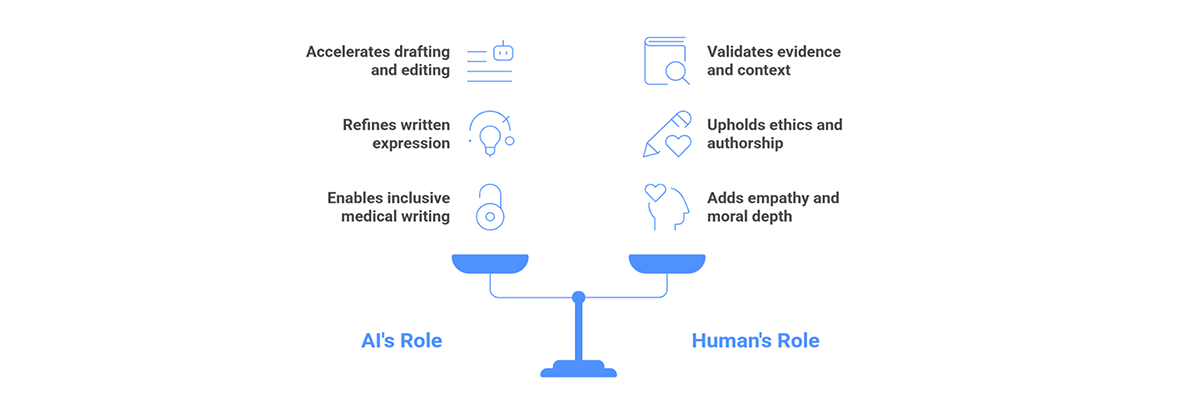
Figure 1. AI and Human Collaboration in Medical Writing. Illustration created using Napkin AI (AI-generated image for illustrative purposes only).
The next chapter of medical writing will not be authored by machines but with them. The challenge ahead is not to resist automation, but to nurture discernment within it. AI may bring linguistic clarity, yet only human consciousness gives writing its moral compass. Responsible adoption isn’t a rule- it’s a rhythm, a continual alignment between intellect and intent, cognition and conscience. Our goal is no longer to create text that merely reads intelligently, but one that thinks ethically.
In this evolving symbiosis of man and machine, medical writers stand as guardians of truth- protecting not just information, but the dignity of knowledge itself. The horizon is radiant yet demanding: a world where algorithms may write, but empathy will always edit. Because in the end, AI can imitate thought- but only humanity can restore meaning.
Disclaimer
Based on HealthMinds’ experience and interpretation. For informational purposes only.
Copyright disclaimer: © 2025 HealthMinds Consulting Pvt. Ltd. All rights reserved.
References
1. Williams A, Smith H, Raja S. Artificial Intelligence in Academic Writing: Opportunities and Risks from Planning to Publication. JBAEM. 2025;1(1):26-32. doi:10.63720/jqz1pdhl
2. Zhang R, Zhang Z, Wang D, Liu Z. Editorial: Responsible AI in healthcare: opportunities, challenges, and best practices. Front Comput Sci. 2023;5:1265902. https://doi.org/10.3389/fcomp.2023.1265902
3. Ahmad A, Bhattacharyya P. Bias in Language Models: A Survey. CFILT, Indian Institute of Technology Bombay. 2024. Available from: Bias_Survey.pdf
4. Hua H, Kaakour A, Rachitskaya A, Srivastava S, Sharma S, Mammo DA. Evaluation and Comparison of Ophthalmic Scientific Abstracts and References by Current Artificial Intelligence Chatbots. JAMA Ophthalmol. 2023;141(9):819–824. doi:10.1001/jamaophthalmol.2023.3119
5. Aljamaan F, Temsah M H, Altamimi I, et al. Reference Hallucination Score for Medical Artificial Intelligence Chatbots: Development and Usability Study. JMIR Med Inform. 2024;12:54345. doi:10.2196/54345